
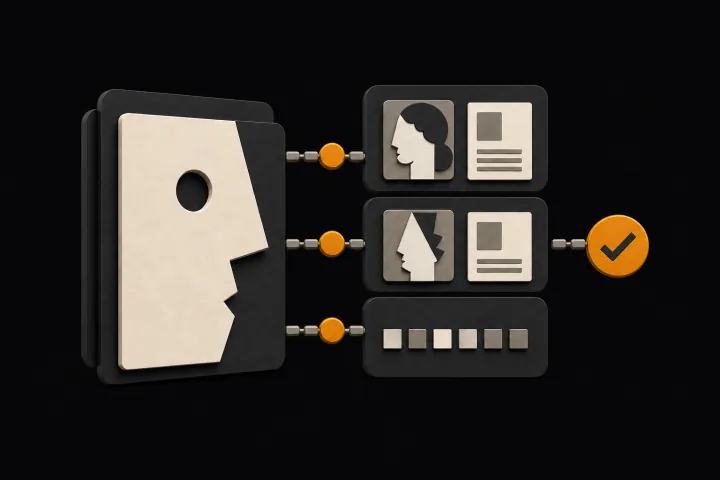
Where face search fits in an OSINT workflow
Reverse face search is useful during discovery. It can connect an input photo to possible public webpages that would be difficult to find with names, usernames, or keywords alone.
The strongest result should become the beginning of a conventional investigation. Open the source, record the page URL and date, inspect the full image, and corroborate the lead with independent public information.
- Crop to the relevant face or use the multi-face selector before searching.
- Record the source URL and page context, not just the result thumbnail.
- Search another clear photo to test whether the same sources reappear.
- Separate confirmed facts from assumptions throughout your notes.
What a visual match cannot establish
A similarity score does not identify a person, prove that two photos show the same individual, establish when an image was taken, or confirm that the source page is truthful. Look-alikes, relatives, manipulated images, and weak source material can all produce misleading leads.
Coverage is also bounded by the VisageDB index. Private accounts, restricted databases, pages behind a login, and public pages that have not been indexed are not searched.
Use face search responsibly
Public availability does not remove the need for judgment. Keep the search proportionate to a legitimate purpose, minimize unnecessary collection, protect sensitive findings, and consider the consequences of publishing a possible match.
Do not use VisageDB to stalk, harass, dox, shame, discriminate against, or exploit anyone. Never search for or attempt to identify minors.
Read the VisageDB Terms of ServiceOSINT face search FAQ
Can a face-search result identify a person?
No. It can point to public webpages containing visually similar faces. Identity requires independent corroboration from reliable sources.
Does VisageDB search private accounts or restricted records?
No. VisageDB searches its index of publicly accessible webpages. It does not access private accounts, restricted databases, or pages behind a login.
Can a visual match be used as evidence on its own?
It should not be. Treat the result as a lead, preserve the original source context, and corroborate it independently before drawing or publishing a conclusion.
What does no result mean in an investigation?
Only that the search did not return a sufficiently similar indexed face. The relevant image may be absent, private, inaccessible, or unsuitable for face detection.
Last updated